
// BOARDS & GRAVITY SPORTS (SKATE/SURF/SCOOTER)
Mastering the Modern Skate Deck: Construction, Concave, and Style
A skate deck is not just a slab of timber; it is the fundamental bridge between rider intuition and kinetic execution. Selecting the right board requires balancing width, wheelbase, and structural laminates against your riding environment, whether grinding concrete curbs or dropping into vertical bowls. Industry-standard seven-ply Canadian maple remains the benchmark for rigidity and pop, yet modern street decks increasingly incorporate composite stringers, cold-press glues, and carbon-infused top layers to resist impact delamination and maintain responsive flex over heavy sessions.
Street culture and aerospace design share a ruthless obsession with weight reduction, tactile control, and structural resilience. The best setups harmonize uncompromising material engineering with distinct visual identity, allowing riders to command the asphalt while asserting an aesthetic that refuses generic corporate repetition.

Anatomy of Wood, Concave, and Wheelbase Geometry
Every high-performance board begins with wood grading and press mechanics. Traditional quality decks rely on hard-rock maple veneers bonded under hydraulic pressure with water-resistant epoxies. Standard street shapes range from 8.0 to 8.5 inches in width, pairing an aggressive steep kick on the nose and tail with medium radial concave. Wider cuts from 8.6 inches upward cater to transition specialists who demand extra foot surface across high-velocity coping carves. Wheelbase spans typically fall between 14.0 and 14.5 inches, directly tuning the pivot radius and leverage points of your trucks.
Across the broader retail industry, premium seven-ply wooden blanks typically retail between and depending on specialized laminates, custom heat-transfer graphics, and regional manufacturing tiers. Sourcing inferior birch alternatives or brittle pre-glued imports often results in flattened concave, early chipping, and sluggish pop within weeks of active street drills.

Dialing In Your Skate Deck for Pure Kinetic Response
Matching board width to footwear geometry and transition terrain prevents heel bite and premature fatigue. Technical ledge technicians favor narrow profiles around 8.125 inches for swift kickflip rotation, while bowl chargers and ditch runners lean toward squared tails and extended wheel wells. Pitfalls frequently arise when skaters pair ultra-wide decks with narrow axles, inducing unstable pivot geometry and violent wheel scrub.
Beyond geometry, the tactile surface demands uncompromising grip and rugged apparel. Pairing your hardware with dialed street apparel like the Hero Cargo-Track Pants and weather-ready Performance Jacket from the WOWLS Fit line ensures free articulation on the concrete without snagging cuffs or tearing ripstop panels during slide-outs.

Arban-Class Architecture and Graphic Longevity
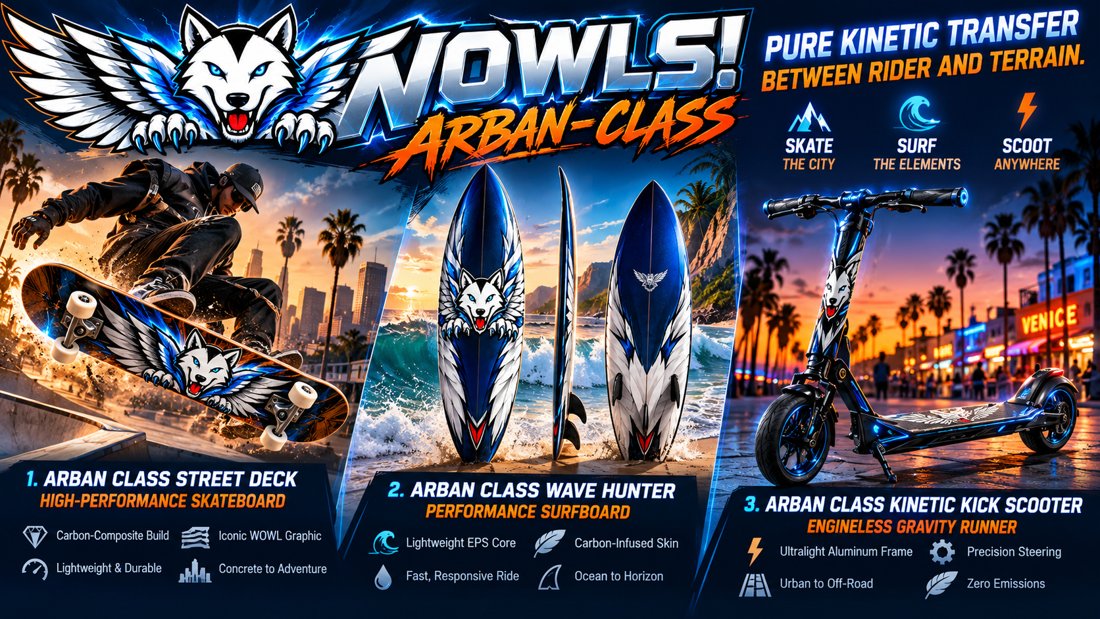
Visual identity on the street should never take a backseat to structural durability. Heat-transfer graphic films applied under controlled curing prevent peeling when skating abrasive ledge wax and salted concrete. WOWLS brings this ethos to the pavement through its Arban-Class concepts, encompassing the Arban Street Deck, the Wave Hunter surfboard, and kinetic kick scooters engineered to ride raw gravity and claim hostile terrain. It channels the Siberian underground mythos born in 1979 into sleek, aerospace-inspired board concepts designed for relentless urban assault.
Riders seeking to expand their lifestyle setup beyond the board can explore curated wearable essentials in the WOWLS Shop, spanning heavy-weight graphic capsules like the Venice Sunset and Neon Metropolis tees, insulated travel tumblers, and all-weather flight gear.

Assembling the Complete Gravity Arsenal
A deck only achieves peak performance when married to calibrated hardware: titanium-axle trucks, high-rebound urethane wheels poured in 99A to 101A durometers, and precision micro-bearing sets. Ignoring the hardware balance compromises the board's structural pop, forcing the wood to absorb uneven torsion that accelerates hairline fractures across the rear truck mounting holes.
Whether you are assembling a raw park setup or styling a personal quiver for downhill cruising, selecting boards shaped with purpose ensures lasting flick and durability. To track the arrival of dedicated Arban-Class gravity prototypes or reserve limited drops, register interest directly through the brand portal.
What deck size should I choose based on shoe size and skating style?
Shoe sizes between US 8 and 10 generally align with deck widths from 8.0 to 8.25 inches for versatile street skating and flatground technical tricks. If your shoe size is 10.5 or larger, or if you primarily skate transition pools and high-speed downhill ditches, step up to a width between 8.38 and 8.75 inches. Wider profiles grant increased footing stability and board control during deep carves, whereas narrower cuts rotate faster during technical flips. Check truck axle dimensions to ensure they align flush with your chosen deck edge.