
// STEM ROBOTICS
Biomimetic STEM robotics for kids and adults
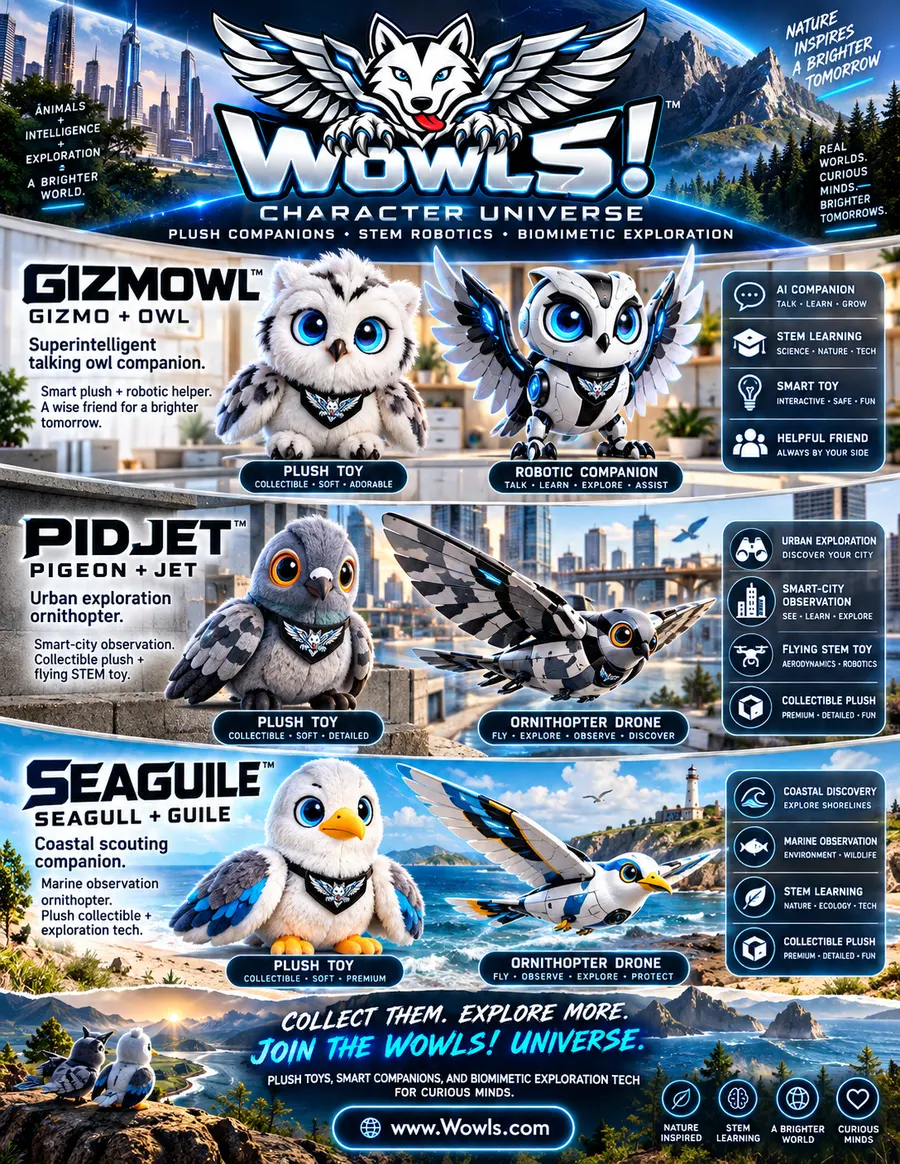
A pigeon banking between buildings and a seagull holding its place above the coast can start a surprisingly serious engineering conversation. WOWLS brings those observations into a character world where curiosity has a face. PIDJET and SEAGUILE turn familiar birds into memorable invitations to ask how wings, bodies and changing air work together.
The same invitation can reach a child holding a plush and an adult sketching a linkage. Character Universe connects collectible companions with biomimetic exploration; Kids supplies a free coloring-book route into aerospace ideas. The most productive starting point is not a grand promise about machines. It is noticing something an animal does and wanting to understand it.

Three character roles give learning a clear starting place
GIZMOWL, the AI Companion, focuses the story on conversation, assistance and learning. PIDJET, the Urban Exploration Ornithopter, points toward flapping-wing movement in a crowded city. SEAGUILE, the Coastal Scouting Companion, looks toward crosswinds, shorelines and environmental observation. Their advanced robotics forms are concepts, but the natural questions behind them are available to explore on an ordinary afternoon.
Ask why a pigeon folds its wings differently during a turn, or how a coastal bird reacts to a gust. A younger learner might draw the position of the wings; an older learner might describe forces and changes in direction. The character gives the exercise continuity. Instead of a disconnected science fact, the observation becomes something PIDJET or SEAGUILE needs to understand about its own habitat.
A paper wing can teach more than a technical slogan
Begin a simple biomimetic activity with paper, a pencil and an observed motion. Sketch an open wing and a folded wing, then use a paper fastener to make a low-risk hinged model. Compare what changes when the moving section is longer or shorter. The purpose is to make relationships visible, not to pretend that one cardboard joint reproduces the complexity of a living bird.
Adults can extend the same question into leverage, joint range, control and stability, keeping powered experiments appropriate to their tools and experience. Children benefit from supervision and a deliberately simple setup. A model that fails to move as expected can be the best part of the session: it gives the group a specific reason to revise the drawing and distinguish a beautiful shape from a working mechanism.
The plush and coloring book make the science approachable
The WOWL Plush Pup is a useful physical anchor for the imaginary side of the exercise. Its gray-and-white body, oversized paws and blue eyes make the hybrid memorable before any discussion of flight begins. Holding a winged wolf also makes the boundary between biology and invention easy to discuss: wolves are real, owls are real, and this particular combination belongs to the WOWLS story.
Kids offers a free 36-page PDF with 22 illustrations, inviting families and educators to color, share and ask questions. A child can choose a sky color, label a wing or invent a destination before tackling formal explanations. The creative act is not a substitute for scientific teaching. It is a way to make a learner care enough about the picture to ask for the explanation.

A family workspace can carry the whole exploration
The Shop’s Expedition Notebook gives sketches a moonlit winged-wolf cover, while the Die-Cut Sticker Pack adds feathers, paw prints, crests and a sitting mascot to the visual vocabulary. A WOWLS LED Night Light brings a blue-glowing emblem to a desk. These are character merchandise, but they can help a shared workspace feel like a place where unfinished ideas are welcome.
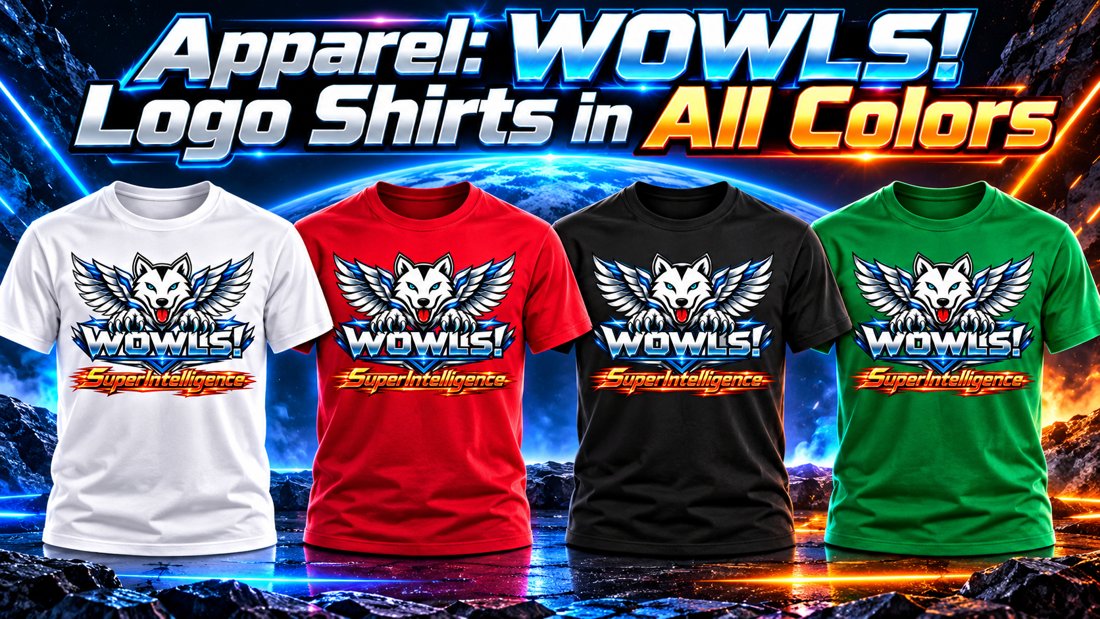
The Cosmic Odyssey Capsule extends the same enthusiasm into clothing, showing a WOWL above the clouds near a glowing planet. Adults drawn to the bigger aerospace imagination can explore Aero and VTOL, then return to the tabletop with better questions about lift and control. That movement between ambitious pictures and modest experiments is the real opportunity: a universe big enough to inspire, and activities small enough to begin.

Can children and adults learn from the same WOWLS robotics themes?
Yes. Start with a shared observation, such as a bird folding its wings, then vary the depth of the activity. Children can draw positions or build simple supervised paper models; adults can investigate linkages, balance and control in more detail. Character Universe supplies memorable roles for those questions, while Kids offers free coloring pages. The current WOWL Plush Pup provides a tangible character companion without needing to function as a robotic teaching device.