
// CUSTOM ELECTRIC MOTORBIKES & CYBER BIKES
Custom Motorcycle Livery: Design Your Cyber Bike
A strong custom motorcycle livery does more than change a bike’s color. It gives the machine a visual identity that survives awkward panel shapes, riding posture and the distance between a screen mockup and a real street. For electric motorbikes and cyber-inspired builds, the best work makes battery housings, exposed frames and compact bodywork feel deliberately connected.
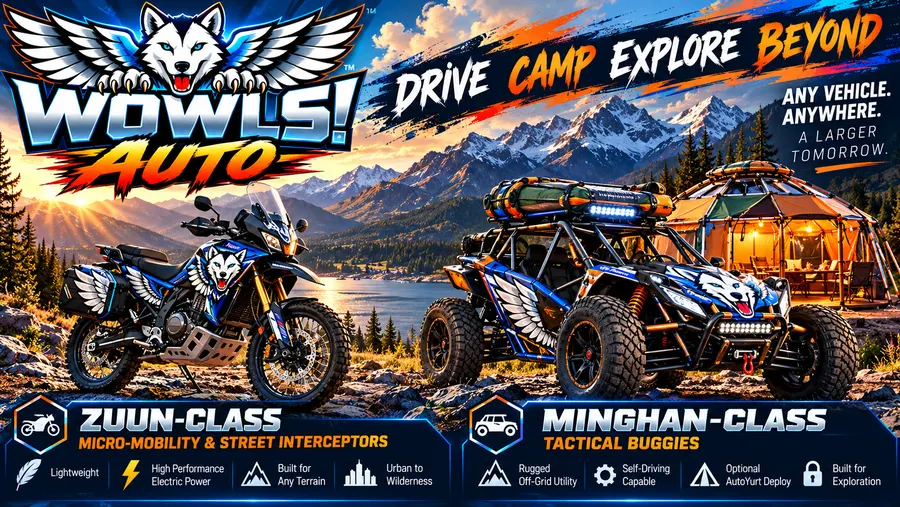
Start with your actual motorcycle, your budget and the surfaces available—not a dramatic rendering on an unrelated silhouette. WOWLS! Auto & Mobility approaches this territory through Exotic Mongolian Livery and winged-wolf imagery, working hand in hand with established custom wrap businesses to develop designs from a customer’s own concept. Its vehicle platforms remain concepts; a private consultation is the starting point.
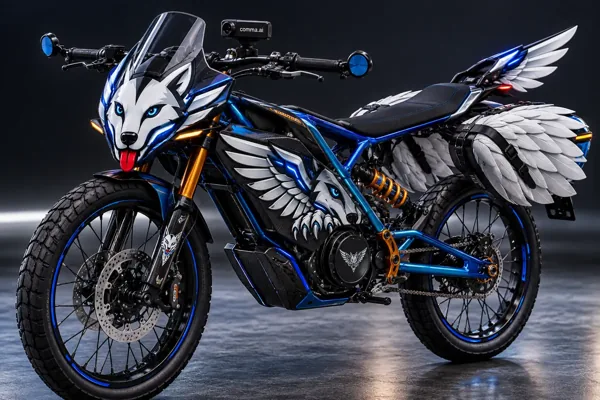
The WOWLS Zuun-Class electric street interceptor has a target weight < 200 lbs, using a titanium and carbon-composite skeletal frame.

Custom motorcycle livery: Wrap, Paint or a Hybrid?
A printed vinyl wrap suits detailed illustration, gradients and repeatable graphics. Colored wrap film works well for broad color changes, while cut-vinyl accents can give a mostly stock bike a coherent identity without covering everything. Paint is often the better route for intricate recesses, certain textured parts or a permanent finish that demands extensive surface preparation.
A hybrid approach can be especially effective on a cyber bike: retain the factory finish on difficult components, wrap the smooth panels and add a few carefully positioned emblems. Inspect the substrate first. Vinyl needs a clean, stable, compatible surface; peeling clearcoat, rough plastics and damaged repairs can undermine adhesion. Removal is not automatically risk-free on compromised paint.
Budget for the Installation, Not Just the Artwork
As broad U.S. industry planning ranges, simple motorcycle graphic packages may run roughly –installed, while extensive custom printed wraps often land around –or more. Detailed original artwork can add several hundred dollars. These are typical market ranges, not WOWLS quotes; location, panel complexity, disassembly and finish requirements can move a project substantially.
Ask whether the estimate includes design revisions, printing, protective laminate, preparation, panel removal and reassembly. A low headline price may cover only supplied graphics. Confirm who handles fragile clips, existing decals and any failed panels before work begins. For an elaborate commission, paying for a physical color sample is usually smarter than approving a saturated screen image.
Make the Electric Architecture Part of the Design
Electric motorcycles often present a different canvas from conventional machines: large battery enclosures, minimal tails and exposed structural members can dominate the profile. Use those shapes instead of disguising them. One strong directional graphic, supported by restrained secondary details, generally reads more clearly than several competing motifs squeezed onto small panels.
Keep cooling openings, charging access, lights, reflectors and required identifiers unobstructed. Specify clearance around removable battery covers and service fasteners. Never treat a vented enclosure as a blank billboard. Review both sides, the front and the rider’s seated view; a design that looks balanced in profile can become visual noise around the cockpit.
Choose Finishes That Survive Real Riding
Specify wrap film intended for vehicle applications, with a compatible protective laminate for printed graphics. Gloss emphasizes color depth; satin can sharpen sculpted surfaces; matte needs care because abrasion can alter its appearance. Request guidance for knee-contact areas, luggage rub points and edges near heat sources. Vinyl is decoration, not a substitute for dedicated abrasion protection.
Seam placement matters more than a promise of seamless coverage. Complex compound curves may require intentional joins rather than overstretched film that later lifts. Ask the installer how the selected material should be washed and maintained, and what workmanship support covers. Avoid directing pressure-washer jets at edges, and follow the installer’s settling-period instructions.
The WOWLS Cyber-Bike Direction
The WOWLS Zuun-Class two-wheeled concept explores a titanium and carbon-composite skeletal frame, a clear windscreen with an integrated winged-wolf mascot, owl-feather panniers and a feather-inspired tail stabilizer. Those forms offer a distinctive creative vocabulary for livery: predatory forward motion, feather geometry and contrasting hard and soft shapes—not merely a logo placed on a fairing.
Zuun also explores comma.ai open-source self driving as a proposed integration, not tested motorcycle compatibility or an endorsed capability. It should not inform assumptions about hands-off riding. For an existing bike, keep the commission grounded in its real hardware: contact WOWLS with model details, clear photographs, preferred colors and a budget range to register interest and request a private custom-build consultation.
Is a custom motorcycle wrap worth it for an electric bike?
Yes, when you want a distinctive appearance without committing to a full repaint and your bike has suitable smooth panels. The value depends on preparation, material selection and installation quality—not simply graphic complexity. Small accent packages can be more effective than full coverage on exposed-frame electric bikes. Before commissioning artwork, have an installer assess battery-cover access, cooling openings, surface condition and panel removal. For a WOWLS-inspired project, request a consultation around your existing motorcycle rather than assuming a concept vehicle is available to purchase.