
// DESIGNER ART TOYS & STEM ROBOTICS
Next-Gen Robot Toy Design: From Collectibles to Biomimetic STEM
The modern robot toy market has evolved far beyond stamped plastic novelties that mindlessly bounce across living room floorboards. Discerning builders, hobbyists, and younger explorers now demand tactile kinetic machines that bridge hands-on aerospace mechanics with visionary storytelling. As space colonization moves from speculative fiction into technical roadmaps, the tools we place in hands must inspire real curiosity about autonomous systems, bio-inspired aerodynamics, and the broader frontiers of exploration.
Across the broader consumer market, robotics options generally divide into two extremes. Basic entry-level novelties usually land in the thirty to eighty dollar range, offering scripted motor routines that wear out quickly. Advanced programmable kits frequently span between two hundred and six hundred dollars, yet they often lock builders into sterile software environments lacking any character narrative. The true sweet spot combines durable physical fabrication, accessible physics principles, and immersive worldbuilding.
Flapping-Wing Physics Over Rigid Rotors
Conventional recreational drones have long relied on exposed multi-rotor configurations. While rigid quadrotors are simple to mass-produce, they introduce notable drawbacks: loud acoustic hums, fragile propeller blades, and high risk during indoor obstacle strikes. In contrast, biomimetic ornithopters leverage flapping-wing locomotion to generate both lift and propulsion simultaneously.
By emulating the wing articulation of avian flyers, biomimetic mechanisms achieve agile, quiet navigation in complex architectural spaces. For emerging aerospace enthusiasts, assembling an ornithopter offers an intuitive masterclass in structural flexibility, harmonic oscillation, and real-world fluid dynamics that rigid-blade copters cannot illustrate.

Evaluating Durability in a Modern Robot Toy
When assessing any automated companion or robotic build kit, the primary pitfall is disposable construction. Flimsy gearboxes and thin ABS snap-tabs frequently sheer under standard kinetic loads. Premium designs prioritize carbon-composite spars, high-tensile gear meshes, and low-friction bearings that endure hundreds of operating cycles.
Equally vital is modularity. A well-engineered learning system allows users to inspect drive linkages and adjust control surfaces directly. Rather than treating hardware like a sealed, throwaway black box, the machine should actively invite teardowns, tuning, and structural experimentation.

Narrative Worldbuilding Meets Physical Hardware
Hardware is only half the equation; emotional resonance transforms a gadget into a lifelong catalyst for exploration. The most compelling designs ground mechanical ingenuity in an expansive story. At WOWLS, that narrative tracks the legendary winged wolves who escaped Siberian subterranean caverns in 1979 to pioneer travel across the Moon and deep cosmos.
Connecting physical artifacts to space colonization captures imaginations that dry schematics leave cold. Tactile play becomes an invitation to explore celestial geology, propulsion engineering, and human resilience across the stars.

The WOWLS Character Universe and Desktop Companions
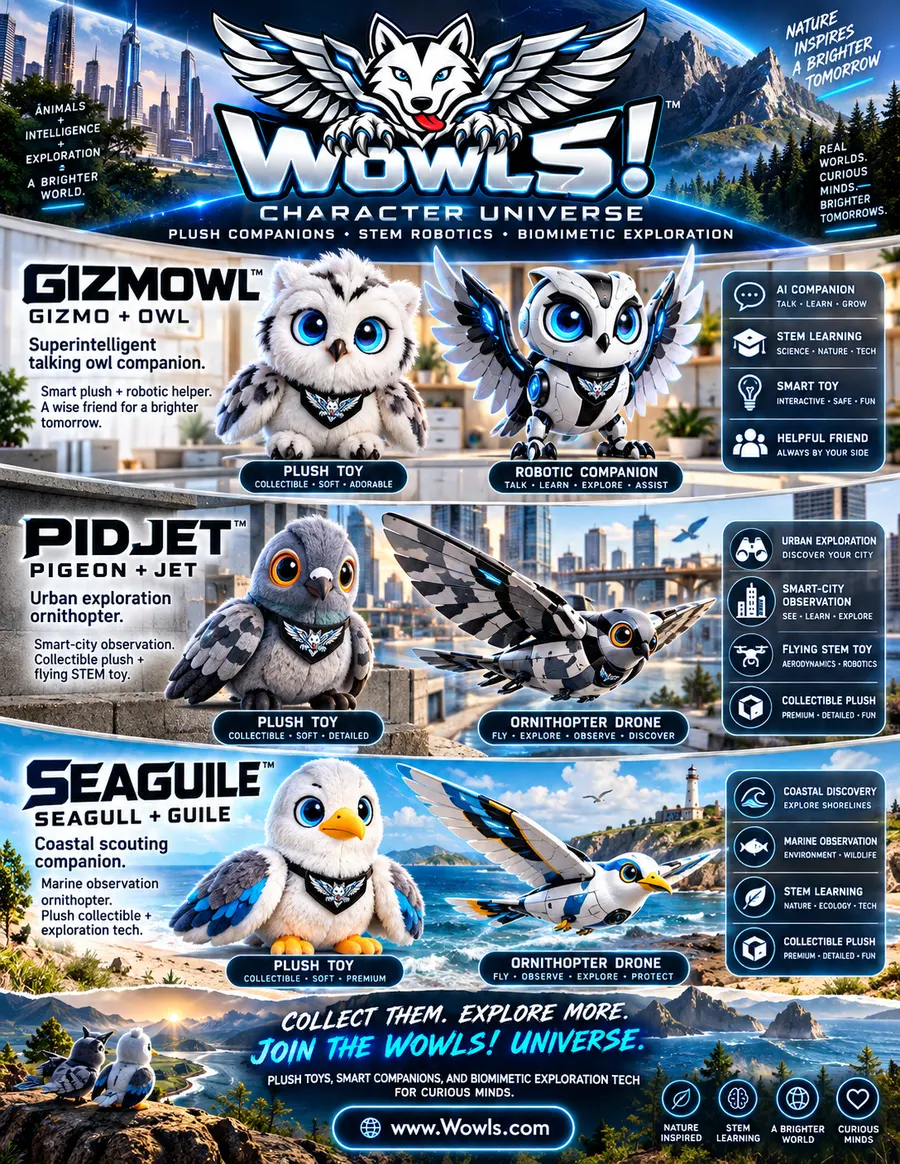
Within the WOWLS Character Universe, mechanical curiosity meets Siberian myth. Concepts like GIZMOWL, PIDJET, and SEAGUILE pair premium plush companions with biomimetic flapping-wing STEM drone concepts currently in development. These bio-inspired fliers are conceptualized to teach aerodynamics and robotic agility through quieter, bird-like flight paths, with interest registration available through our waitlist.
For immediate desktop inspiration, the WOWLS shop delivers available artifacts today. Collectors can secure the WOWL Plush Pup—complete with oversized paws and bright blue eyes—alongside the Aero Guardian Figurine, the Winged Wolf Wood-Look Sculpture, and the 1,000-piece Cosmic Jigsaw Puzzle, each designed in Los Angeles to anchor the interplanetary mindset.
What distinguishes biomimetic robot toys from conventional multi-rotor drones?
Biomimetic robotics emulate organic mechanics, such as the articulated wing kinematics of birds, rather than spinning rigid bladed propellers. This flapping-wing approach produces significantly lower acoustic noise, improves collision survivability indoors, and delivers superior agility through confined corridors. Because the flexible airfoils generate lift and forward thrust simultaneously, they offer hands-on lessons in dynamic lift coefficients, aeroelasticity, and natural physics that standard quadrotors simply cannot demonstrate.