
// PROPULSION SYSTEMS AND ENGINE TECHNOLOGY TERM
Adaptive Cycle Engine
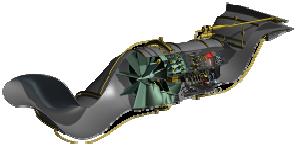
An adaptive cycle engine is an advanced jet engine designed to efficiently operate across a wide range of flight conditions, from slow speeds to very fast speeds, by changing its internal configuration. It can act like a fuel-efficient engine for cruising and then reconfigure itself for high-speed flight.
TECHNICAL DEFINITION
An Adaptive Cycle Engine (ACE) is a next-generation aerospace propulsion system featuring variable geometry and a multi-stream architecture, often incorporating a third airflow stream, enabling it to dynamically reconfigure its thermodynamic cycle and bypass ratio to optimize performance and fuel efficiency across a broad flight envelope, spanning subsonic to hypersonic speeds.
BACKGROUND
A variable cycle engine (VCE), also referred to as adaptive cycle engine (ACE), is an aircraft jet engine that is designed to operate efficiently under mixed flight conditions, such as subsonic, transonic and supersonic.
READ MORE ON WIKIPEDIASYNONYMS & ALIASES
- Variable cycle engine
- Three-stream engine
- Next-generation adaptive propulsion
- Variable bypass engine
- Adaptive engine
USAGE NOTE
These engines are primarily developed for advanced military aircraft, especially sixth-generation fighter jets, to achieve extended range and superior performance across diverse mission profiles.
DEVELOPERS
Organizations developing technology related to Adaptive Cycle Engine.
A leading developer of aerospace engines, GE Aerospace is actively developing adaptive cycle engine technology, including the XA100 engine for the U.S. Air Force's Adaptive Engine Transition Program (AETP), designed to provide increased thrust and fuel efficiency for next-generation fighter aircraft.
A major aerospace engine manufacturer, Pratt & Whitney is a key competitor in the adaptive cycle engine space, also developing engines for programs like the AETP. Their work focuses on advanced propulsion systems that can switch between high-thrust and high-efficiency modes.
The AFRL leads the research and development efforts for advanced aerospace propulsion technologies for the U.S. Air Force, including significant involvement in the Adaptive Engine Transition Program (AETP) which aims to develop and demonstrate adaptive cycle engines.
NASA's aeronautics research includes fundamental studies and technology development for advanced propulsion systems, such as variable cycle engines and other concepts that contribute to adaptive cycle engine technology, often for future commercial and military applications.
DARPA funds high-risk, high-reward research into innovative technologies. While not directly building engines, DARPA's programs often lay the groundwork for advanced propulsion concepts, including those that inform adaptive cycle engine development, pushing the boundaries of aerospace capabilities.